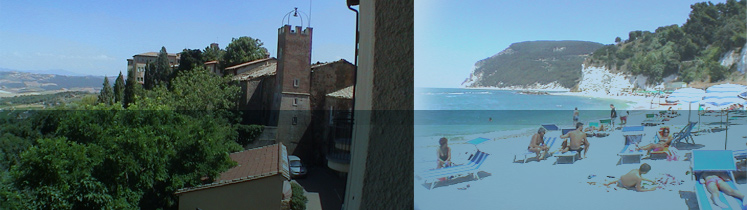
This is a brief introduction to the UNESCO designated World Heritage site Radicofani, a small enchanting village in the Orcia Valley in Tuscany.
The beautiful Fortress of Radicofani, constructed on an enormous mass of basaltic rock, rises at the southern extremity of the Orcia Valley, on a hill between Mount Amiata and the border with Umbria and Lazio. It can be reached easily from the Via Cassia.
From the fortress the view sweeps over an unforgettable panorama stretching from the Amiata Mountain towards the region of Lazio with great views of lake Bolsena , the Chiana Valley, the Orcia Valley and lake Trasimeno. The Umbria region is also visible and on clearer days, the Appenine mountain range.
Documentary evidence of the fortress exists as early as 978 dc while the most recent restoration works were completed in 1997.
Radicofani is also known thanks to the historical figure of Ghino di Tacco exiled from Siena, who, at the end of the 12th century, took possession of the castle. With swift and unexpected raids, he stripped passing merchants and pilgrims travelling along the nearby Via Francigena of their riches and belongings. Property of the monks of the Abbey of SS. Salvatore, it then passed under the control of the Papal State, and so under the Republic of Siena and subsequently under the Medicis.
In the village there are other monuments worth seeing, like the striking Romanesque Church of San Pietro (Saint Peter), with its collection of Della Robbia terra-cottas along with the wooden statue of the 'Madonna del Castello' (Madonna of the Castle), whose sculptor is Francesco di Valdambrino.
In Radicofani the Town Hall is in the former palazzo Pretorio (Magistrates Building), with coats of arms in travertine on its façade of the Podestà of the Siena Republic. Along the ancient Via Cassia it is also possible to see the Palazzo della Posta, a marvellous Medici Villa.
Nowadays the village of Radicofani and the surrounding Orcia Valley are part of the unique 'Sienashire'.
For its historic and cultural value, the Orcia Valley has been recognised by UNESCO, who designated it a World Heritage Site.
By: Maria Fitzgerald
born in Italy in 1965, University Degree in German and English. Specialisation in German at the 'Albert Ludwig' University in Freiburg (Germany). Works as a translator (German, English and Italian) and teacher of Italian for Foreigners. Married to an Irish man, one child, she spends her time between Ireland and Italy. Collaborates as book reviewer for Lettera.com.